For service businesses, thriving in today’s digital world means more than just having an online presence; it demands a sophisticated and adaptive digital marketing strategy. As of September 2026, with 5.79 billion social media users globally and search engine algorithms constantly evolving, simply existing online is no longer enough to capture attention or drive growth. The landscape is competitive, and the rise of AI and generative engine optimization (GEO) has fundamentally reshaped how potential clients discover and interact with services.
To truly connect with clients and foster lasting relationships, service businesses need a comprehensive, forward-thinking digital roadmap. This means creating tailored approaches that address specific business goals and customer needs. Many successful businesses achieve this by implementing customized digital marketing solutions designed to resonate deeply with their target market.
In this extensive guide, we will explore the core pillars of effective digital marketing strategies. We will clarify how a robust strategy differs from mere campaigns and tactics, and delve into understanding your target audience through meticulous segmentation and buyer persona development. We will also identify the most impactful digital channels for service growth, discuss smart resource allocation, and outline the key performance indicators (KPIs) essential for tracking success. Finally, we’ll address common pitfalls and explain how to adapt your strategy to the dynamic, AI-driven era of digital marketing.
A high-performing digital marketing strategy for a service business is built upon a clear understanding of its overarching business objectives and market positioning. It’s not just about being online; it’s about strategically leveraging digital channels to achieve specific, measurable outcomes. This involves a holistic view of owned media (your website, blog, email lists), paid media (ads on search engines, social platforms), and earned media (PR, mentions, shares), all working in concert to guide potential clients through their customer journeys. The goal is to move prospects from initial awareness to conversion and, ultimately, to loyal advocacy. A well-defined strategy acts as the blueprint, ensuring every digital effort contributes to the larger vision.
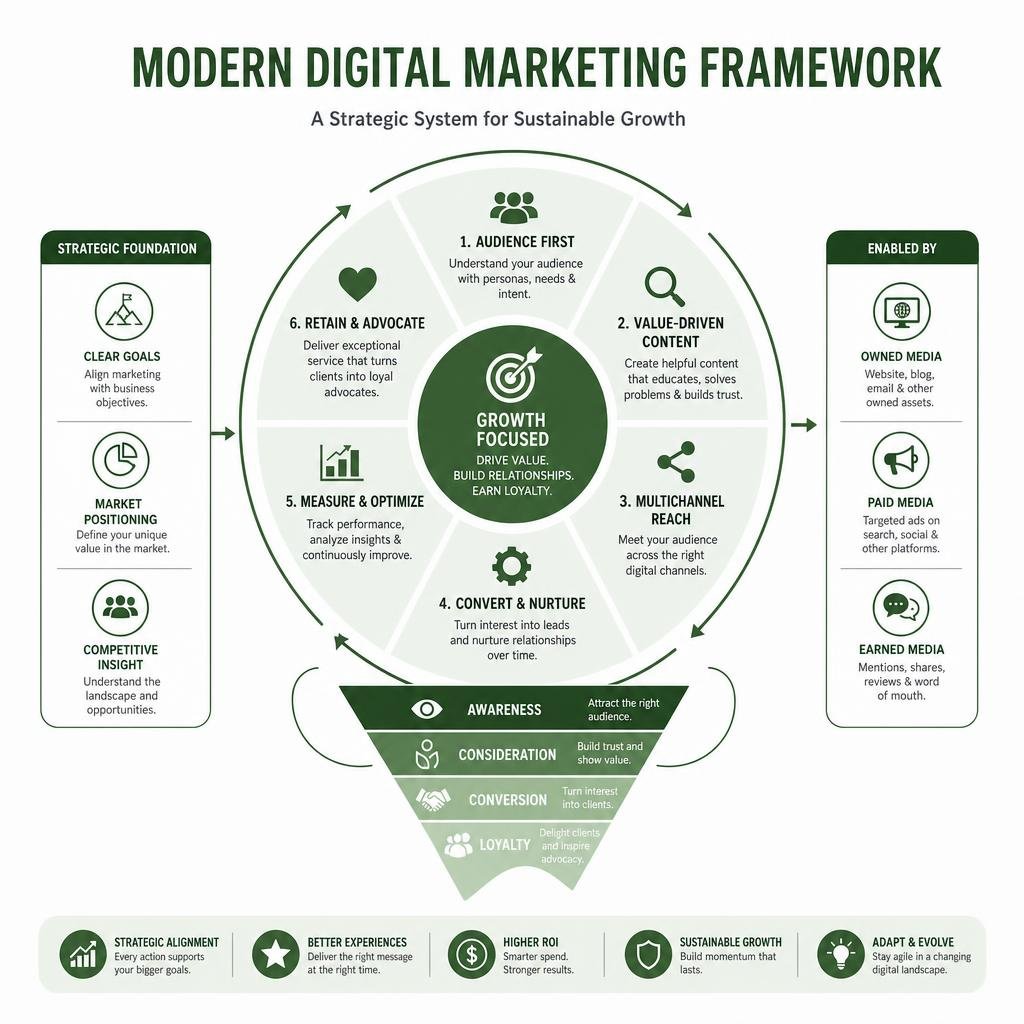
Table of Contents
How Digital Marketing Strategies Differ From Campaigns and Tactics
Understanding the distinction between strategy, campaigns, and tactics is fundamental to effective digital marketing. A digital marketing strategy is the overarching, long-term plan that defines your vision, sets high-level goals, identifies your target audience, and outlines the broad approaches you’ll take across digital channels to achieve your business objectives. It’s the “why” and the “what” – for instance, “We will become the leading provider of [service] in [region] by increasing online inquiries by 30% over the next two years.” This strategic alignment ensures that all subsequent efforts are purposeful and contribute to a unified direction.
Marketing campaigns, on the other hand, are time-bound initiatives designed to achieve specific, shorter-term goals that support the broader strategy. A campaign might focus on a particular product launch, seasonal promotion, or lead generation drive. For example, to support the strategy of increasing online inquiries, a campaign might be “Generate 50 qualified leads for our new consulting service in Q4.” Campaigns have a defined start and end date, specific objectives, and allocated resources.
Tactics are the granular, day-to-day actions and operational workflows executed within a campaign. These are the specific tools and methods used to achieve campaign goals. For our lead generation campaign, tactics could include: running a series of targeted LinkedIn ads, publishing a downloadable whitepaper, optimizing landing page conversion rates, and sending a follow-up email sequence. Tactics are the “how” – the practical steps taken.
The relationship is hierarchical: the long-term vision of the strategy informs the goals of various campaigns, and campaigns are executed through a multitude of specific tactics. Without a clear strategy, campaigns and tactics can become fragmented, inefficient, and fail to deliver sustainable results.
Audience Segmentation and Buyer Persona Development
At the heart of any successful service business strategy is a deep understanding of its ideal clients. This begins with audience segmentation, which involves dividing your broader market into smaller, more manageable groups based on shared characteristics. These characteristics can include demographics (age, location, income, industry), psychographics (values, interests, lifestyle), behavior (online activity, purchase history), and needs (pain points, challenges).
Once segments are identified, the next crucial step is developing buyer personas. These are semi-fictional representations of your ideal clients within each segment, based on market research and real data about your existing customers. A persona goes beyond basic demographics to include:
- Background: Job role, industry, company size (for B2B services).
- Demographics: Age, gender, income, location.
- Identifiers: Communication preferences, tech savviness.
- Goals: What they want to achieve, what success looks like for them.
- Challenges/Pain Points: Obstacles preventing them from reaching their goals.
- Search Intent: What keywords or questions they use when searching for solutions.
- Objections: Reasons they might hesitate to use your service.
For a service business, understanding these nuances allows for the creation of highly relevant marketing messages and the selection of appropriate channels. For instance, a persona for a B2B consulting firm might be “Sarah, the Mid-Market Marketing Director,” who is overwhelmed by data and seeking proven strategies to improve ROI. Knowing Sarah’s pain points and where she seeks information (e.g., LinkedIn, industry webinars) enables us to craft content and outreach that directly addresses her needs. This meticulous approach to understanding your client base is crucial for developing truly effective marketing efforts.
Essential Digital Channels and Levers for Service Growth
To effectively reach and engage your target audience, service businesses must strategically deploy various digital channels. An omnichannel approach ensures consistent messaging and a seamless experience across all touchpoints, from initial discovery to conversion and beyond. This integrated strategy aims to build local visibility, optimize for organic search, streamline conversion paths, and foster long-term client retention.

Local SEO and Generative Engine Optimization (GEO)
For many service businesses, particularly those with a physical location or a defined service area, Local SEO is paramount. It focuses on improving your visibility in local search results, such as Google Maps and the local pack (the top three business listings that appear for local queries). Key strategies include:
- Google Business Profile (GBP) Optimization: Claiming and thoroughly optimizing your GBP listing with accurate business information, hours, services, photos, and regular posts. This is often the first point of contact for local clients.
- Citation Authority: Ensuring consistent Name, Address, Phone (NAP) information across online directories (Yelp, Yellow Pages, industry-specific sites).
- Local Content: Creating content that speaks to local issues or events, demonstrating community relevance.
- Online Reviews: Actively soliciting and responding to client reviews on GBP and other platforms, as reviews significantly influence local search rankings and client trust. As of April 2026, 20% of local searches begin directly on map platforms like Google, Apple, and Bing Maps, highlighting the importance of this channel.
The rise of AI has introduced Generative Engine Optimization (GEO), a new frontier for digital marketing. With AI-powered search engines and chatbots increasingly providing direct answers to user queries, the goal shifts from merely ranking high to being cited by these generative engines. This means:
- Entity Optimization: Clearly defining your business, services, and location as distinct entities within your content and schema markup, making it easy for AI to understand and extract information.
- Fast Load Speeds: Websites with under 2-second load times are 40% more likely to be referenced by AI, emphasizing the need for technical optimization.
- Structured Content: Organizing your website content with clear headings, concise answers to common questions, lists, and tables, which AI can easily parse for direct answers.
- High-Utility Content: Creating authoritative, fresh, and comprehensive content that AI models deem trustworthy and valuable for their responses. Content updated within 30 days is three times more likely to be cited by AI.
GEO complements traditional SEO by ensuring your service business is not just found by human searchers but also recognized and referenced by the AI systems that are increasingly mediating information discovery.
Paid Media and Strategic Content Marketing
Beyond organic visibility, paid media offers service businesses immediate reach and highly targeted advertising opportunities. This includes:
- Paid Search (PPC): Running ads on search engines like Google Ads to appear at the top of search results for high-intent queries (e.g., “accountant near me,” “business consulting services”). This provides instant visibility and measurable traffic.
- Social Media Advertising: Leveraging platforms like LinkedIn, Facebook, and Instagram to target specific demographics, interests, and professional roles with tailored ad campaigns. With 5.79 billion social media users worldwide, these platforms offer unparalleled reach.
- Retargeting: Showing ads to users who have previously interacted with your website or social media, keeping your service top-of-mind.
To maximize the effectiveness of paid media, it must be integrated with a robust strategic content marketing plan. Content marketing focuses on creating and distributing valuable, relevant, and consistent content to attract and retain a clearly defined audience. For service businesses, this often means:
- Educational Content: Blog posts, whitepapers, case studies, and webinars that address client pain points, demonstrate expertise, and build trust. This positions your business as a thought leader.
- Video Marketing: Producing explainer videos, client testimonials, service demonstrations, or short-form content for platforms like TikTok and Instagram Reels. Video content drives higher engagement and conversion rates, and short-form video is increasingly prioritized by platform algorithms for organic reach.
- Email Marketing: Building an email list and nurturing leads with personalized newsletters, service updates, and exclusive offers.
The synergy between paid media and content marketing is powerful. Paid ads can drive traffic to high-value content, which then educates and converts prospects. This combined approach, often informed by data-driven digital marketing insights, ensures that every marketing dollar is spent effectively, leading to better ROI and sustainable client acquisition. To ensure these diverse channels work harmoniously, many businesses seek comprehensive digital strategy development that integrates all aspects of their online presence, offering a cohesive client experience.
Resource Allocation and Performance Measurement
Effective digital marketing isn’t just about implementing various tactics; it requires strategic allocation of resources and rigorous measurement of performance. Without a clear understanding of where your budget and efforts are yielding the best returns, even the most innovative strategies can fall short. This section will explore how service businesses can optimize their spend and track meaningful KPIs to drive growth.

Allocating Budget and Resources Across Digital Marketing Strategies
Budgeting for digital marketing is a critical exercise that directly impacts the success and scalability of your service business. On average, paid online channels account for 69% of total digital spend, and paid media can consume around 30.6% of marketing budgets. However, effective allocation goes beyond simply assigning percentages; it involves a nuanced approach:
- Define Clear Objectives: Each dollar allocated should align with specific, measurable goals (e.g., increase lead generation by X%, improve brand awareness by Y%).
- Understand Your Audience’s Journey: Allocate resources to the channels where your target audience spends their time and where they are most receptive to your message. For instance, if your B2B clients are active on LinkedIn, a larger portion of your budget might go to LinkedIn ads and thought leadership content.
- Channel Diversification vs. Focus: While it’s tempting to be everywhere, spreading resources too thin can dilute impact. Often, it’s more effective to focus on 2-3 core channels that yield the best results, rather than trying to manage 10 different channels simultaneously (the average number of channels companies market across).
- Balance Paid and Organic: Paid media offers immediate results and scalability, while organic strategies (SEO, content marketing) build long-term equity and authority. A healthy balance ensures both short-term gains and sustainable growth.
- Digital Infrastructure and Tools: Don’t overlook the budget for essential tools like CRM systems, marketing automation platforms, analytics software, and content creation resources. These are the backbone of efficient execution.
- Testing Reserves: Always set aside a portion of your budget for experimentation with new channels, ad formats, or content types. The digital landscape evolves rapidly, and continuous testing is vital for staying competitive.
- Performance-Based Adjustments: Budget allocation should not be static. Regularly review performance data and be prepared to shift resources from underperforming channels to those delivering higher ROI.
For service businesses seeking comprehensive support in managing their digital presence, exploring various digital marketing solutions can provide the strategic guidance and operational expertise needed to optimize budget and resource allocation effectively.
Tracking Meaningful KPIs and Ongoing Strategic Reviews
Measuring the success of your digital marketing strategy requires tracking the right Key Performance Indicators (KPIs) and conducting regular, thorough reviews. Focusing on “vanity metrics” (e.g., raw follower counts) without tying them to business outcomes is a common pitfall. Instead, concentrate on metrics that directly reflect your business objectives:
- Lead Generation: Number of qualified leads, Cost Per Lead (CPL).
- Conversion Rates: Website conversion rate (e.g., form submissions, demo requests), lead-to-client conversion rate.
- Customer Acquisition Cost (CAC): The total cost of sales and marketing efforts needed to acquire a new client.
- Customer Lifetime Value (CLV): The predicted revenue a client will generate over their relationship with your service business.
- Return on Ad Spend (ROAS): Revenue generated for every dollar spent on advertising.
- Website Traffic & Engagement: Organic traffic, bounce rate, average session duration, pages per session.
- Pipeline Revenue & Velocity: The value of potential deals in your sales pipeline and how quickly they move through it.
- Brand Mentions & Sentiment: Especially important for earned media and reputation management.
High-maturity marketers often triangulate across three or more methodologies to measure both short- and long-term effects of their brand investments. Regularly tracking these KPIs allows you to understand what’s working, what’s not, and where to optimize.
Strategic reviews should not be an afterthought. While core strategies might have a 1-3 year horizon, they should be reviewed at least quarterly. These reviews involve:
- Performance Analysis: Comparing actual results against set goals and KPIs.
- Market Scan: Assessing changes in the competitive landscape, client behavior, and technological advancements (e.g., new AI capabilities).
- Strategy Iteration: Making necessary adjustments to campaigns and tactics based on performance data and market shifts. This ensures your strategy remains agile and responsive to the dynamic digital environment.
Common Execution Pitfalls and AI-Era Adaptation
Even with a well-defined strategy, execution can stumble due to common pitfalls. For service businesses, avoiding these traps and adapting to the rapidly evolving AI landscape is crucial for sustained success.
One frequent mistake is focusing on vanity metrics that look impressive but don’t correlate with actual business growth. High website traffic is good, but if it doesn’t translate into qualified leads or conversions, it’s not truly effective. Similarly, a large social media following means little if engagement is low and it fails to drive client acquisition.
Another pitfall is operating with fragmented channels where different digital marketing activities run in silos without coordination. This leads to inconsistent messaging, duplicated efforts, and a disjointed client experience. An integrated, omnichannel approach is essential to ensure all touchpoints work together towards common goals.
The rapid pace of technological change, particularly with the rise of AI, presents both opportunities and challenges. As of September 2026, 48% of marketers admit they haven’t fully figured out how to adapt their strategies to the broad use of AI. This lack of adaptation can lead to missed opportunities and a competitive disadvantage.
The emergence of AI and generative engine optimization (GEO) has fundamentally shifted the digital landscape. AI-powered search engines are increasingly providing direct answers to user queries, potentially reducing click-through rates to websites. This means service businesses must focus on being cited as an authoritative source by these AI systems. Strategies include:
- Content Freshness and Authority: AI prioritizes up-to-date, high-utility content from credible sources. Regularly updating your service descriptions, case studies, and blog posts is paramount.
- Structured Data and Schema Markup: Implementing schema markup helps AI understand the context and entities on your website, making it easier for it to extract information.
- Optimizing for Natural Language Queries: As voice search and AI assistants become more prevalent, optimizing content for conversational, question-based queries is vital.
- Focus on E-E-A-T (Experience, Expertise, Authoritativeness, Trustworthiness): Building strong E-E-A-T signals is crucial for gaining the trust of both human users and AI algorithms.
Furthermore, the integration of automated agents and AI-driven chatbots can enhance both marketing and customer service experiences. Chatbots can handle routine inquiries, qualify leads, and provide instant support, freeing up human staff for more complex interactions. However, relying too heavily on automation without a human touch can lead to a sterile client experience.
Finally, content fatigue is a growing concern. With an abundance of information available, standing out requires not just more content, but better, more personalized, and highly relevant content. 78% of marketers desire more personalized content than they currently produce, highlighting a significant gap. AI can assist in personalization, but the core strategy must still be human-centric and value-driven.
Frequently Asked Questions About Digital Strategy
How often should a service business update its digital marketing strategy?
While the core foundational elements of a digital marketing strategy (your long-term vision, target audience, and overarching goals) might remain stable for 1-3 years, the execution plan requires frequent adjustments. We recommend treating your strategy as an annual blueprint that guides your efforts, but conducting quarterly adjustments is crucial. This allows you to respond to algorithm updates, shifts in client behavior, emerging technologies like generative AI, and competitive movements. Regular reviews ensure your tactics remain effective and your resources are optimally allocated, preventing your strategy from becoming outdated in a dynamic digital environment.
How do AI-powered search engines affect digital marketing visibility?
AI-powered search engines fundamentally change how information is discovered. Instead of just presenting a list of blue links, AI can provide direct answers to user queries, often synthesizing information from multiple sources. This means that simply ranking #1 for a keyword may not guarantee a click if AI provides the answer directly. For service businesses, the focus shifts to ensuring your brand is cited as a reliable source. Key considerations include:
- Brand Citations: Optimizing your content to be easily understood and referenced by AI models.
- Crawl Speed and Structured Data: Ensuring your website is technically sound, fast-loading, and uses schema markup to help AI parse your content effectively. Pages loading under 2 seconds are 40% more likely to be referenced by AI.
- High-Utility Content: Creating comprehensive, authoritative, and regularly updated content that AI deems trustworthy and valuable for its responses. Content updated within 30 days is three times more likely to be cited by AI.
- Generative Engine Optimization (GEO): A new approach focused on entity signals and structuring content for AI extraction, rather than just keyword density.
What is the ideal budget split between paid and organic channels?
There isn’t a universally “ideal” split, as it heavily depends on your service business’s goals, industry, competitive landscape, and growth stage. However, a common approach involves balancing immediate impact with long-term equity. Paid media, accounting for a significant portion of digital spend (around 69% of total digital spend, and 30.6% of marketing budgets for many companies), offers instant visibility, precise targeting, and scalability for rapid lead generation or promotional pushes. It’s excellent for driving traffic for time-sensitive launches or specific offers.
Organic channels (SEO, content marketing, social media organic efforts) build long-term organic equity, authority, and trust. While they take longer to yield results, they often provide a lower customer acquisition cost over time and create a sustainable flow of inbound leads. Many businesses aim for a split that allows for consistent paid activity to maintain visibility and drive immediate results, while simultaneously investing in organic strategies to build a durable foundation. A good starting point might be to allocate a larger portion to paid initially for quick wins, then gradually shift more resources to organic as its momentum builds, ensuring a balanced approach that supports both short-term revenue goals and sustainable growth.
Conclusion
Navigating the complexities of the digital landscape in September 2026 requires more than just an online presence; it demands a sophisticated and adaptive digital marketing strategy. For service businesses, this means embracing strategic clarity, understanding the profound difference between overarching strategy and tactical execution, and meticulously developing buyer personas to truly connect with clients.
By leveraging essential digital channels like Local SEO, Generative Engine Optimization (GEO), paid media, and strategic content marketing, businesses can build robust pipelines for growth. Smart resource allocation and rigorous performance measurement through meaningful KPIs are critical for optimizing spend and ensuring every effort contributes to measurable business outcomes.
As AI continues to reshape how clients discover and engage with services, service businesses must remain agile, avoiding common pitfalls and continuously adapting their strategies. The businesses that will thrive are those that embrace continuous optimization, prioritize high-utility content for AI citation, and integrate their digital efforts into a cohesive, client-centric experience. By doing so, service businesses can achieve sustainable growth, foster lasting client relationships, and maintain operational agility in an ever-evolving digital world.
Wait! Before You Go, Read:
 Mastering SEO & Marketing: Effective Strategies for Financial Firms to Outpace Their Competitors
 Expanding Your Industrial Equipment Business with Digital Marketing Strategies
 8 Effective Digital Marketing Tools for your Business in 2023
 Benefits of Engaging In Digital Marketing
 Practical Strategies to Streamline Cross-Border Payments for Small Businesses
 Smart Domain Strategies for Passive Income: Building Digital Assets That Last
 The New Wave of Digital Payments (For Users And Businesses)
 Simple Strategies to Help Small Businesses Grow Faster and Build Long-Term Success
 Top Strategies for Localized Marketing to Increase Brand Awareness
 10 Best Digital Marketing Jobs You Can Do From Home
 3 Digital Marketing Tips for Professionals Selling their Services
 Top 10 Email Marketing Tools For Small Businesses
 What Makes Some Businesses Show Up First On Google In Singapore With Local SEO?
 How Data-Driven Decisions Are Shaping the Future of Digital Marketing
 How SEO Helps Aussie Small Businesses Get Found Without Paying for Every Click
 Social Media Monitoring: Strategies, Tools, and Best Practices
 Tips For Combining SEO & Content Marketing
 13 Tips for Small Businesses to Get Involved in the Community Through CSR
 Modern Web Implementation: Best Practices & Strategies
 High Touch Customer Service: Elevate Your Business Relationships
 7 Benefits of Using a Customer Service Language
 5 Factors that Small Businesses Overlook in Their Website
 Micro-SEO Strategies: 6 Foolproof Ways to Boost Rankings
 The Best Proposal Software for Modern Businesses
 How Small Businesses Can Benefit from Cryptocurrency Payment Integration: A Complete Guide