The popular advice is simple. Pick an AI blog generator, publish more often, and growth will follow. That advice confuses speed with usefulness. Generative AI has become routine work, not a novelty. McKinsey’s Global Survey on AI found that 72% of organizations were using generative AI in at least one business function in early 2024, compared with 56% in 2021. Widespread use doesn’t mean an untouched draft is ready for readers.
After ChatGPT launched in November 2022, Reuters reported in November 2023 that it had reached 100 million weekly active users. Prompting became normal. Publishing judgment didn’t become automatic. A generator is most useful when you treat it as the start of an editorial workflow, not the end of one.
Table of Contents
What an AI Blog Generator Hands You
An AI blog generator turns a prompt about a topic, audience, tone, structure, or keyword into an editable outline, draft, rewrite, or set of metadata. It’s a productivity tool for early production. It isn’t a database, a fact store, or a publisher who takes responsibility for the finished article.
That distinction matters because generated text often sounds settled before anyone has checked it. Google’s guidance on using generative AI content explains that language models predict likely word sequences from learned patterns, so fluent output can still contain unsupported claims. Google recommends manual fact-checking and review before publication, particularly for statistics, quotations, medical or financial claims, and time-sensitive information.
What the Generator Supplies and What You Still Do
| Task | Generator output | Human work required | If you skip it |
|---|---|---|---|
| Outline and first draft | Structured draft from the brief | Angle, examples, and voice | A generic post any site could publish |
| Facts and statistics | Fluent but unverified claims | Sources, dates, and quotation checks | Unsupported or invented numbers |
| SEO metadata | Titles, descriptions, and headings | Intent match and natural wording | Keyword stuffing or the wrong promise |
| Rewrites | Clearer or shorter paragraphs | Decisions about what to cut | Smooth text with no point of view |
| Links and calls to action | Suggested placements | Real URLs and real offers | Broken, invented, or off-topic links |
Say a small software site asks for a post about choosing an invoicing tool. The generator can propose headings, a comparison structure, and fluent paragraphs within minutes. It can’t know which tool the writer tested, which price changed last week, or which customer problem matters most. You still choose those points.
The Draft Rule
Practical rule: Treat every output as a draft, require a source for every factual claim, and send high-risk passages through a person.
Readability alone doesn’t prove reliability. A paragraph can be clear, confident, and wrong. That’s the main failure mode to design against. High linguistic fluency can mask low factual reliability, especially when a sentence includes a number, a date, a quoted speaker, or advice that affects health or money.
A useful first check is blunt. Mark every claim you’d need to defend if a reader challenged it. Keep the ones you can support, rewrite the ones you can verify, and delete the rest. Metadata needs the same discipline. A title may contain the keyword but promise a comparison the article never delivers. A suggested link may look plausible but point nowhere useful.
The generator hands you starting material. You supply the angle, evidence, lived detail, and final decision. If your review doesn’t change anything except a few commas, you probably haven’t reviewed the draft. You’ve only admired how complete it looks.
How a Generator Builds the Draft
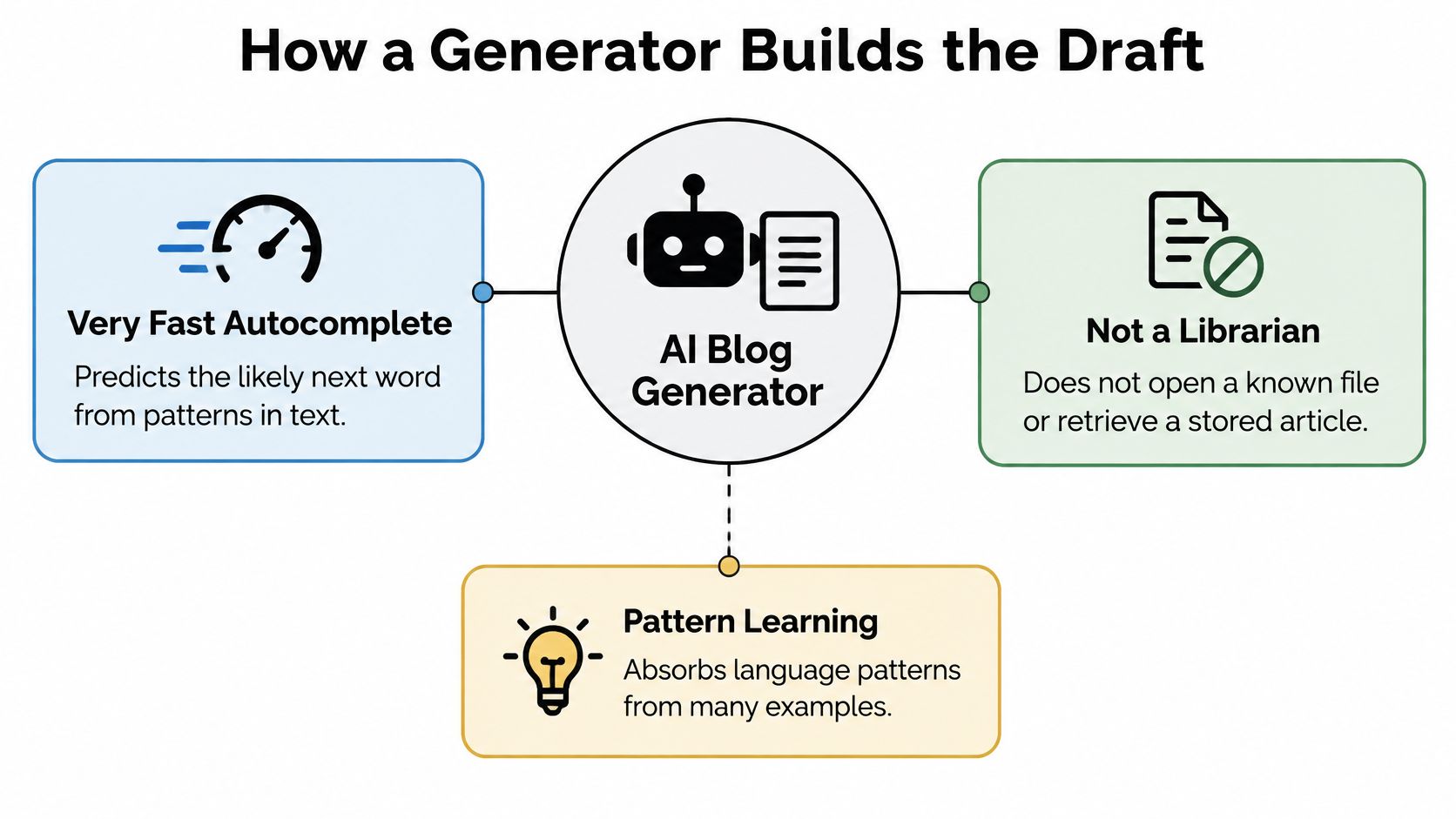
A generator works more like very fast autocomplete than a librarian opening a known file. It has absorbed patterns from large amounts of text and predicts a likely next word, then the next one. The sentences build word by word, guided by your prompt and the wording already produced.
That explains a common confusion. A confident paragraph isn’t necessarily retrieved from a checked source. It may be a plausible continuation. If you ask for a tip, the model produces language shaped like thousands of tips it has encountered, whether or not that tip fits your reader.
The diagram below separates prediction from retrieval so you can see what the tool is, and isn’t, doing.
Retrieval Changes the Starting Point
Retrieval-augmented generation, or RAG, adds a research step before drafting. The system retrieves relevant documents, places useful passages into the prompt, and asks the model to draft from those passages rather than from pretrained knowledge alone. A Cambridge Data and Policy study found that RAG-assisted models significantly outperformed models relying only on pretrained knowledge in an evaluated educational-text setting. It also found that GPT-4 Turbo surpassed GPT-3.5 Turbo in accuracy and coherence, especially for short-answer responses.
For blogging, don’t treat retrieval as a magic accuracy switch. Constrain it by the target query and the publication date. Keep a passage-level citation or evidence link beside each generated claim. An editor can then open the exact passage, check its context, and decide whether the draft represented it fairly.
Settings Worth Looking For
- Query-bound retrieval: Sources are fetched for the article’s specific question, not a broad topic.
- Date controls: Older material can be excluded when prices, rules, or product features matter.
- Visible evidence links: Each claim stays attached to a passage an editor can inspect.
- Export that preserves links: Citations don’t disappear when text moves into your publishing system.
Retrieval can still fetch the wrong document. A source can be stale. The model can misread a correct passage and repeat the error fluently. RAG raises your odds of getting a checkable draft. It doesn’t remove the edit, and it doesn’t transfer responsibility from the publisher to the software.
How to Edit a Draft into a Useful Post
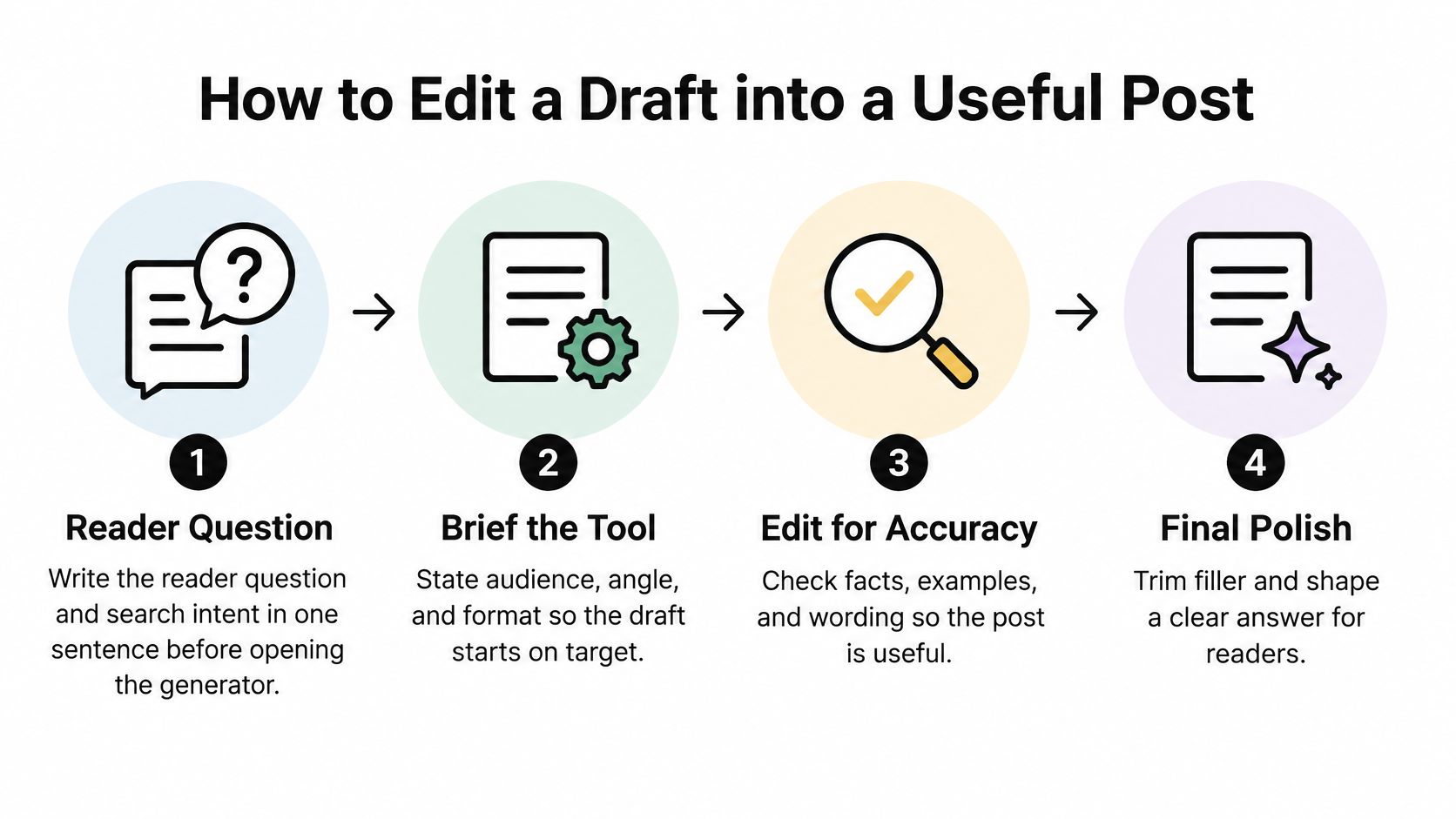
Don’t start by asking for a finished article. Start with the decision the reader is trying to make. The process below turns a short generated draft into material you can defend, understand, and improve.
The four broad phases are shown here, before the detailed steps.
Eight Steps From Draft to Post
-
Write the reader question first. State the question and search intent in one sentence before opening the generator. This prevents a polished answer to the wrong problem. Common slip: briefing with a keyword when the reader wants a comparison, a cost check, or a troubleshooting fix.
-
Brief the tool with audience and angle. Add who it’s for, what they already know, sources you trust, and what the post should not claim. A bare topic invites generic coverage. A clear angle gives the draft a reason to exist beside competing pages.
-
Generate a short structured draft. Ask for raw material rather than a complete article, such as an outline, draft paragraphs, title options, and a meta description. NoPassiveIncome offers a free mini generator that can supply that first pass alongside planning utilities. Short output is easier to inspect before errors multiply.
-
Replace generic examples. Add a firsthand case, a named comparison, a screenshot description, a failed attempt, or a current figure you can cite. The generator can’t supply your experience. If every example could appear on any competitor’s site, the post still has no distinguishing evidence.
-
Check every high-risk claim. Verify numbers, quotations, dates, product details, and statements affecting money, health, or legal choices against a source. Delete anything you can’t support. When you need another structured pass over wording and consistency, these expert proofreading tips can help organize the final review.
-
Run a readability check. Use a Flesch-based analyzer or read the draft aloud. Split sentences that bury the point, replace abstract nouns with concrete actors, and move the answer higher. A readability score isn’t the goal. Faster understanding is.
-
Give each section one job. Cut repeated advice and paragraphs that restate the introduction. If two sections explain the same trade-off, keep the clearer version and use the saved space for an example, limit, or decision rule.
-
Add working links and a matched next step. Open every URL yourself. Make sure internal links support the current point and the call to action matches the reader’s stage. A beginner guide shouldn’t end by pushing an advanced purchase without explanation.
What Done Looks Like
A useful post lets a new reader identify who it helps, which claims are sourced, and what to do next.
Test that standard with someone who didn’t see the prompt. Ask what question the post answers and which parts they trust least. Their answers expose weak evidence and buried conclusions quickly. The generator saves blank-page time. The edit creates the post.
Drafting SEO Articles and Images With Outrank
A generator can help publish more often, but more drafts do not automatically make a site more distinctive. Ordinary how-to articles and analysis designed to be cited by AI answer systems are different jobs. Outrank’s tools may help with production, while editors still need to choose the angle and judge whether a draft is worth publishing.

What Outrank Adds to the Workflow
According to its website, Outrank offers SEO-focused article generation, keyword research, content customization, custom images, and publishing integrations. The site describes tools for shaping drafts and fitting them into a content workflow, but available features and limits depend on the vendor’s current plans. Check its AI blog generator page before choosing a plan.
Those features address different handoffs. Keyword research can help shape the brief; article generation produces a starting draft; image creation adds a visual asset. Publishing integrations may reduce manual transfer between tools. Each step still needs editorial judgment: a relevant keyword does not guarantee a useful angle, and an image that matches a topic may not strengthen the article.
A solo writer testing one draft may need only a starting point. A business managing a steady publishing process may value tools that bring drafting and related tasks together. In either case, inspect the claims, replace generic examples, check image relevance, and confirm that headings answer the reader’s search intent before publishing.
Outrank may suit teams whose bottlenecks include article drafting, image creation, or moving content into publishing tools. If you need only an occasional outline, a broader platform may add little. The useful comparison is between the manual steps it can reduce and the editorial work it cannot replace. More output can fill a calendar, but it does not by itself make routine how-to content distinct or turn a post into a source for AI citations.
Why Rankings and AI Citations Differ
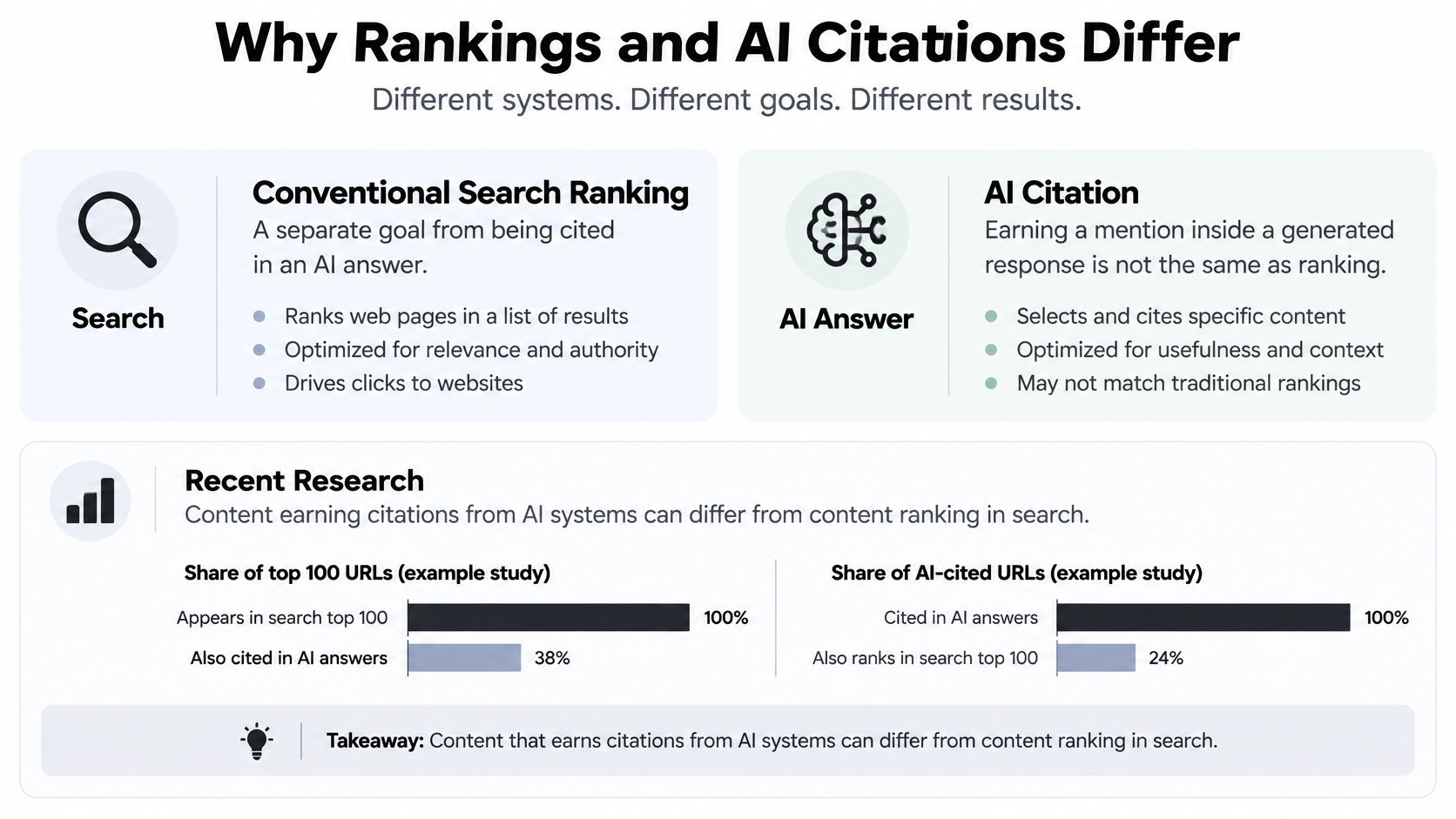
Ranking in conventional search and being cited in an AI answer aren’t the same achievement. A page can hold a strong organic position and never appear inside an AI response. Another page can be cited because it gives the system a clear, sourced point worth repeating.
The comparison below keeps those goals separate before you look at the numbers.
The Citation Evidence
A study reported by Business Insider found that trends and analysis were cited 78% of the time, while standard how-to guides were cited only 12% of the time. The same study found that the top 10 organic pages received 55% of organic sessions but only 29% of AI-referred sessions. It also found that almost half of the top 100 organic pages received no AI referral traffic.
| Content or page group | Reported result | What it signals |
|---|---|---|
| Trends and analysis | Cited 78% of the time | Strongest candidate for AI citation |
| Standard how-to guides | Cited 12% of the time | Weak citation candidate despite search demand |
| Top 10 organic pages | 55% of organic sessions, 29% of AI-referred sessions | Top rank does not guarantee AI visibility |
| Top 100 organic pages | Almost half receive no AI referral traffic | Ranking and citation diverge |
The gap between 78% and 12% challenges a common production habit. Asking a generator for another templated how-to can raise publishing volume while weakening differentiation. The draft may answer a familiar query, but give AI systems little original analysis to cite.
Prompt for Material Worth Citing
Ask for an evidence-led structure instead of a generic outline. Request an original comparison, dated data, expert attribution, clear definitions, and an interpretation of what the evidence means for your reader. During editing, add firsthand results and current figures that only your publication can supply. A balanced approach to writing for users and search engines keeps keywords subordinate to a useful answer.
Imagine two posts about email subject lines. One lists familiar tips. The other compares results by audience type, dates the test, names its limits, and explains where the pattern breaks. The second is easier for a reader, and an AI system, to quote accurately.
That doesn’t guarantee discovery in ChatGPT, Gemini, or AI Overviews. Answer engines choose sources themselves. Your work is to make the page specific, current, and traceable enough to deserve citation. Keywords alone don’t create that value.
Signals That Show a Post Is Working
A citation screenshot isn’t a business result. AI visibility moves too much to support that simple reading. A 2026 academic analysis of AI-search results found that only about 35% of cited sources overlapped from one day to the next, implying roughly 65% changed daily. The same source notes separate publisher research reporting that only 1% of Google searches ending in an AI Overview produced a click on one of the cited sources.
Those findings expose two separate mistakes. First, a source list captured today may not repeat tomorrow. Second, being cited doesn’t automatically produce referral traffic. Treat AI visibility as a probabilistic signal, not a stable ranking position.
What Each Content Signal Does and Does Not Prove
| Signal | What it shows | What it does not show | Check cadence |
|---|---|---|---|
| Indexed pages | The URL can be discovered | That readers benefited | After publication, then monthly |
| Branded mentions | The name is being repeated | That the mention is positive or profitable | Monthly |
| AI citations | A system used the page as a source | Stable rank or referral traffic | Same prompts across several dates |
| Assisted conversions | The page played a role in a signup or sale | That AI citation caused it | Monthly against a baseline |
| Direct traffic | Some people return or type the site | Which article they remember | Monthly |
| Query visibility | The topic appears for a prompt today | That it will appear tomorrow | Repeated tests, several platforms |
Read across the scorecard instead of chasing one row. Indexed pages answer a technical question. Mentions show recognition. Assisted conversions, email signups, sales, and publisher revenue connect the article to an outcome. A broader view of SEO metrics helps keep those categories separate.
Test the same prompts on repeated dates and more than one platform, then record the result beside the date. You’ll see volatility you’d miss in a one-time check. Also compare the post against a baseline before crediting the generator. A seasonal topic, newsletter mention, or internal-link change may explain the movement.
Don’t promise yourself guaranteed rankings or guaranteed AI citations. No prompt controls either system. The useful question is narrower and harder. Does the edited post bring qualified visits, signups, or revenue over time? A generator that emits many posts but produces no durable outcome hasn’t solved your publishing problem. It has automated output.
Limits Fluency Will Not Warn You About
Smooth prose can hide stale facts. The sketch below is a useful reminder that a polished interface doesn’t equal verified knowledge.

Time-sensitive claims are the costliest edge case. A price, product rule, platform feature, or legal requirement can change after the model’s sources were gathered. The sentence keeps its confident tone. Nothing in the style warns you that the fact underneath it expired.
Where Review Must Get Stricter
Advice affecting health, money, safety, or legal decisions needs a higher review bar than a software roundup. The reader’s possible loss is larger, even when both drafts look equally polished. Route those passages to a person qualified to judge them, and remove claims you can’t support.
Quotations create a special risk. A plausible speaker beside a plausible sentence isn’t a real quotation. Find the original wording, speaker, and context, or paraphrase without quotation marks. Don’t let a generator manufacture authority by inventing who supposedly said something.
The short video below adds another view of the publishing risks that remain after a draft looks complete.
Template scale creates a quieter problem. Hundreds of near-duplicate posts can make a site look active while giving readers nothing distinct to learn. Every unchecked draft multiplies the same factual and structural weaknesses. It also consumes the editing time needed for sourced comparisons and original interpretation.
A generator can’t see your analytics, customers, failed experiments, corrections, or commercial relationships. Those are often the details worth adding by hand. If generated copy supports sponsored material, disclose the sponsorship and use the link attributes that placement requires. The limit isn’t bad writing. The tool can write smoothly about things it hasn’t verified and experiences it never had.
Start With One Post and a Human Edit
Choose one upcoming post, not a batch. Write the reader question, the search intent, and two sources you already trust at the top of a blank document. That short brief becomes your control sheet for everything the generator produces.
Use an AI blog generator only for the first pass. Ask for a short structured draft, several title options, and a meta description. Keep the output small enough to inspect line by line. If the first version arrives as a long, complete-sounding article, cut it back to the claims and sections you can verify.
A One-Post Test You Can Finish This Week
- Brief: State the audience, angle, desired action, and claims the draft must avoid.
- Draft: Generate raw material, then stop instead of asking for more volume.
- Edit: Add one firsthand detail or original comparison and attach sources to factual claims.
- Check: Remove dated, duplicated, or unsupported material and test every link.
- Measure: Record indexing, mentions or citations, and one business result across several dates.
Publish only after a person who didn’t write the prompt can explain the post back to you. Ask them who it helps and what they would do next. If they can’t answer, the problem may be intent or structure, not sentence quality.
One carefully edited post teaches you whether the workflow saves time without lowering the standard. If it works, repeat the same brief, draft, edit, measure loop with another topic. If it doesn’t, change the brief or the angle before generating anything else. Don’t commission a hundred posts to discover that the process was weak.
Pick the next post already on your calendar and run the one-post test this week. Write the question and two trusted sources first, generate only a short draft, then spend your saved time on verification and one original addition. Publish that edited version, record indexing and one meaningful outcome on several dates, and scale the workflow only after this single post proves it can meet your standard.
Wait! Before You Go, Read:
 How to Write Engaging and SEO Optimized Blog Posts
 The Definitive Guide to Writing Roundup Posts That Go Viral
 How To Attract Your Blog Posts – 20 Tips For Normal People
 How to Use WhatsApp to Get Blog Traffic (2025 Guide)
 4 Jedi Mind Tricks That Get Elite Bloggers to Accept Your Guest Posts
 How Long Should a Blog Post Be for SEO?
 How To Reply To Comments In A Clear And SEO Friendly Manner On My Blog?
 Why Your Blog Gets No Traffic (And 6 Data-Backed Ways to Fix It)
 I’ll Never Read Your Posts Again, You Know Why?
 15 Solid Tips About Creating Great Content for Your Blog
 How Do You Choose a Blog Niche That Actually Works?
 How to Write a Blog Post in a Short Time – 5 Points to Follow
 How to Rank a Blog Post on Google: Tips and Tricks!
 8 Tips for Experienced Bloggers – How to Build a Better Blog
 How To Write a Great Text When You Have No Inspiration
 7 Actionable Ways to reduce Your Blog Bounce Rate
 Guest Blogging Tips – Step by Step Guide for Every Blogger
 How to Create Effective Use Case Pages: A Step-by-Step Guide
 5 Ways To Create Passive Income with a Blog
 When Is it Time to Hire Out for Social Media Posts for Your Business?
 Is Blogging Worth It in 2026? What’s Changed and What Hasn’t
 10 Ways to Reduce Bounce Rate on Your Blog
 How to REALLY Make Money with Sponsored Posts
 Do you lack Creativity in your writing? Here’s what to do
 Top 5 Little-Known Reasons Why Your Blog Will Never Make You Money (How To Fix It)