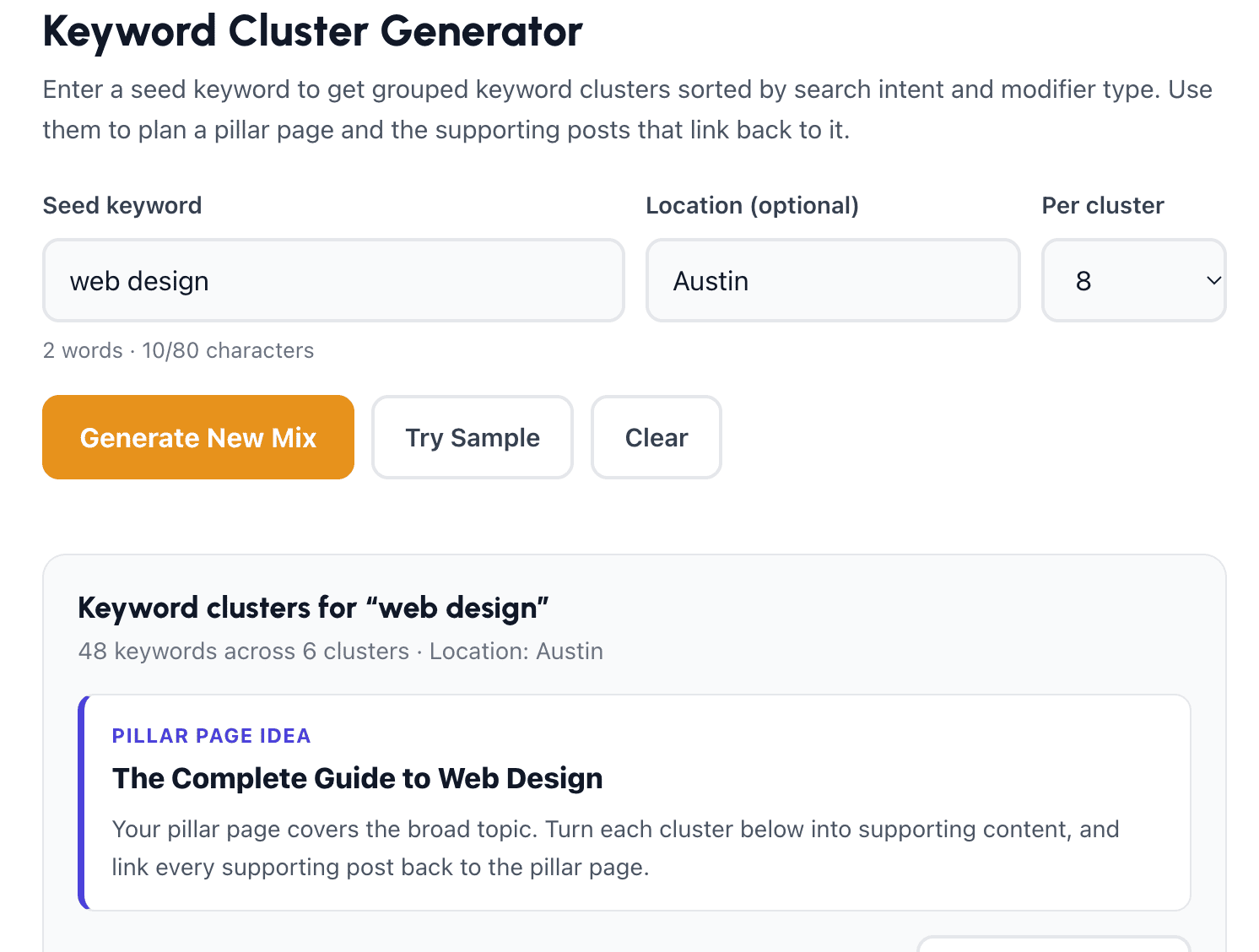
Quick answer: A keyword cluster generator groups related search terms by topic and intent, helping you organize a blog content hub around a central pillar page and supporting subtopics. To use one effectively, start with a seed keyword, generate and categorize related terms, map them to a pillar-and-cluster structure, then build internal links connecting each piece back to the hub. This approach improves topical authority and search visibility.
Building a blog that ranks well isn’t about publishing as many posts as possible. It’s about organizing content so search engines—and readers—understand how your topics connect. That’s where a keyword cluster generator comes in.
A keyword cluster generator analyzes a broad topic and breaks it into related keyword groups based on shared intent, semantic similarity, or search behavior patterns. Instead of guessing which keywords belong together, you get a structured map of terms that naturally group into subtopics. This map becomes the blueprint for a content hub: one comprehensive pillar page supported by multiple cluster articles, all internally linked.
Content hubs built this way tend to perform better in search because they signal topical depth to search engines. Google’s own documentation on E-E-A-T (Experience, Expertise, Authoritativeness, Trustworthiness) emphasizes that sites demonstrating comprehensive coverage of a subject tend to be viewed as more authoritative. A scattered blog with disconnected posts rarely achieves that same signal.
This guide walks through exactly how to use a keyword cluster generator to plan a content hub from scratch, including how to choose your seed keyword, interpret clustering results, and translate that data into a content calendar that actually gets built.
Table of Contents
What is a keyword cluster generator?
A keyword cluster generator is a tool that takes a broad seed keyword and produces groups of semantically related search terms. Rather than returning a flat list of keyword variations, it organizes terms by topic, search intent, or linguistic similarity.
Most keyword cluster generators work by analyzing search engine results pages (SERPs), identifying which keywords tend to rank on the same pages, and grouping them accordingly. If two keywords consistently surface similar results, the tool assumes they share enough intent to be targeted by a single piece of content.
Common tools that offer keyword clustering functionality include Ahrefs, SEMrush, Keyword Insights, and SurferSEO. Each uses slightly different clustering logic, but the output is generally the same: clusters of related terms grouped under broader topic categories.
Why use a keyword cluster generator for content hub planning?
Planning a content hub manually is time-consuming and prone to gaps. Keyword cluster generators solve two problems at once: content redundancy and content gaps.
It prevents keyword cannibalization
When two blog posts target overlapping keywords without a clear differentiation in intent, they compete against each other in search results instead of one of them ranking strongly. This is known as keyword cannibalization. A keyword cluster generator flags overlapping terms early, before you’ve written duplicate content.
It surfaces subtopics you might miss
Even experienced content strategists can overlook valuable long-tail keywords. Clustering tools pull from real search data, surfacing related queries that might not come to mind through brainstorming alone. This helps ensure your content hub actually covers the full breadth of what your audience is searching for.
It supports a stronger internal linking structure
A well-organized cluster map makes it obvious which articles should link to which. Each cluster keyword becomes a candidate for a supporting article that links back to the pillar page, reinforcing both user navigation and search engine crawlability.
How do you choose the right seed keyword for clustering?
The seed keyword is the foundation of your entire content hub, so choosing it carefully matters more than any other step in this process.
Choose a seed keyword if it meets three criteria: sufficient search volume to justify a hub, broad enough scope to support multiple subtopics, and direct relevance to your audience’s core problem. A seed keyword that’s too narrow (like “how to clean a French press”) won’t generate enough clusters to build a hub. One that’s too broad (like “coffee”) will generate clusters so varied that no single hub can meaningfully cover them.
A practical middle ground might be something like “home coffee brewing methods” or “email marketing automation.” Both are specific enough to stay focused, yet broad enough to spin off 15–30 related subtopics.
Before feeding your seed keyword into a generator, ask whether this topic represents a core service, product category, or expertise area for your business. Content hubs work best when they’re built around topics you can speak to authoritatively and sustain content production for over time.
How do you generate and interpret keyword clusters?
Once you’ve chosen a seed keyword, the next step is running it through your chosen tool and making sense of the output.
Step 1: Input the seed keyword
Enter your seed keyword into the clustering tool. Most platforms will ask you to specify a target location and search engine, since keyword volume and intent can vary by region.
Step 2: Review the generated clusters
The tool will return a list of keyword groups, usually labeled by a representative term or topic. Each cluster typically includes anywhere from 5 to 50 related keywords, depending on the breadth of the seed term and the size of the available search data.
Step 3: Evaluate search intent within each cluster
Not all keywords in a cluster share identical intent, even if they’re grouped together. Review each cluster manually and separate keywords into informational (how-to, what-is), commercial (best, vs., comparison), and transactional (buy, pricing, near me) categories. This distinction determines what type of content each cluster should produce—a blog post, a comparison page, or a product page.
Step 4: Prioritize clusters by opportunity
Rank your clusters based on search volume, keyword difficulty, and relevance to your business goals. Choose a cluster as a priority if it combines moderate-to-high search volume with manageable competition and clear alignment to a product or service you offer. Deprioritize clusters with high difficulty scores unless your site already carries strong domain authority in that space.
How do you structure clusters into a pillar-and-cluster content hub?
Once your clusters are organized, the next step is translating them into an actual content structure.
Designate your pillar page
The pillar page should target your seed keyword directly and provide a broad overview of the topic. It should be comprehensive enough to address the main questions a reader has, while linking out to more detailed cluster articles for anything that requires deeper coverage. Pillar pages are typically longer-form—often 2,000 words or more—since they aim to rank for a competitive, high-volume term.
Assign cluster articles to subtopics
Each keyword cluster becomes the basis for one supporting article. For example, if your pillar page covers “email marketing automation,” your clusters might include “email automation workflows,” “abandoned cart email sequences,” and “email automation tools comparison.” Each of these becomes its own article, targeting the cluster’s primary keyword and related long-tail variations.
Build the internal linking structure
Every cluster article should link back to the pillar page, and the pillar page should link out to each cluster article. This creates what’s often called a “hub and spoke” model. Search engines use these internal links to understand topical relationships between pages, which can strengthen the ranking potential of the entire hub—not just individual pages.
Map out a publishing timeline
Content hubs rarely launch all at once. Choose a phased publishing schedule if your team has limited content production capacity, prioritizing the pillar page and two to three supporting articles first, then expanding the hub over subsequent months. This approach lets you validate search performance before committing resources to a full build-out.
What are common mistakes to avoid when building a content hub from keyword clusters?
Treating every cluster as equally important
Not every cluster deserves a full article. Some clusters may be better served by a short FAQ entry or a section within another article. Evaluate volume and intent before committing writing resources to every single cluster a tool generates.
Ignoring search intent mismatches
A keyword cluster generator groups by linguistic similarity, not always by precise intent. Always manually review clusters before building content around them, since a tool might group an informational query with a commercial one simply because they share overlapping terms.
Failing to update clusters over time
Search behavior shifts. New keywords emerge, and seasonal trends can shift keyword volume significantly. Revisit your keyword clusters every two to three months to catch emerging opportunities or declining relevance within your hub.
Skipping the internal linking step
Even a well-researched hub underperforms if the internal linking structure isn’t built out. Each piece of content should explicitly link to the pillar page and at least one or two related cluster articles.
Turning keyword clusters into a content hub that performs
A keyword cluster generator doesn’t just save time. It gives you a data-backed foundation for building a content hub that search engines can understand and readers can navigate easily. The real work happens after the clustering: evaluating intent, prioritizing opportunities, and building a linking structure that ties everything together.
Start small. Choose one seed keyword, generate your clusters, and map out a pillar page with three to five supporting articles. Publish, measure performance over a few months, and expand the hub based on what’s actually driving traffic. A content hub built this deliberately tends to outperform scattered, one-off blog posts by a wide margin, both in search rankings and in how well it serves the people reading it.
Frequently Asked Questions
How much does a keyword cluster generator cost?
Pricing varies by tool. Platforms like Ahrefs and SEMrush include keyword clustering as part of broader SEO subscriptions, typically ranging from $99 to $200+ per month. Dedicated clustering tools like Keyword Insights offer standalone plans, often starting around $58 per month for lower usage tiers.
How long does it take to build a content hub from keyword clusters?
Timelines depend on team size and content volume, but a basic hub with a pillar page and three to five cluster articles typically takes four to eight weeks to research, write, and publish. Larger hubs with 15+ supporting articles can take several months to fully build out.
What’s the difference between keyword clustering and basic keyword research?
Basic keyword research produces a flat list of related terms and their search volumes. Keyword clustering goes a step further by grouping those terms into topic-based categories based on shared intent or SERP overlap, making it easier to plan content structure rather than just individual keyword targets.
Can I build a content hub without a keyword cluster generator?
Yes, but it requires more manual effort. You can approximate clustering by researching “People Also Ask” questions, analyzing competitor content structures, and grouping keywords by hand based on search intent. A generator simply speeds up this process and reduces the chance of missing relevant subtopics.
Who should use keyword cluster generators?
Choose a keyword cluster generator if you’re responsible for planning content at scale, such as an SEO strategist, content marketer, or blog editor managing multiple writers. Solo bloggers publishing infrequently may find manual keyword grouping sufficient, since the time saved by automation matters less at lower content volumes.
Wait! Before You Go, Read:
 AI Blog Generator Guide for Useful Posts
 Ubersuggest: Keyword Research Made Easy (And Free!)
 How Long Should a Blog Post Be for SEO?
 15 Solid Tips About Creating Great Content for Your Blog
 How to Rank a Blog Post on Google: Tips and Tricks!
 How to Apply The 80/20 Rule in Blog Content Marketing
 Should You Update Old Blog Posts for SEO? Here’s the Verdict
 A Guide to Keyword Targeting and On-Page SEO
 5 Best SEO Tools for Bloggers – They Will Help You Get More Traffic For Your Blog
 How to Write Engaging and SEO Optimized Blog Posts
 How To Create A Social Media Marketing Content Plan
 Why Your Blog Gets No Traffic (And 6 Data-Backed Ways to Fix It)
 Tips For Combining SEO & Content Marketing
 How Do You Choose a Blog Niche That Actually Works?
 Topical Authority: How to Build Niche Authority in 7 Steps
 How to Recognize a Perfect Guest Post – Tips to Get Your Content Approved
 How To Reply To Comments In A Clear And SEO Friendly Manner On My Blog?
 4-Step Plan You Need to Make $2,000/Month with High-Ticket Offers
 Get Paid to Write at HireWriters (Or Order Quality Original Content)
 BoostContent: Make Money With Your Writing Skills or Boost Your Content Marketing
 10 Ways to Reduce Bounce Rate on Your Blog
 How to Create a Quality Content Strategy for a Mobile App?
 Your Rent Is Your Real Runway: How to Plan Housing Costs Before Going Full-Time
 5 Free But Fantastic Google Tools Every Serious Content Marketer Should Never Ignore
 5 Powerful Content Leveraging Tactics To Earn High Authority SEO Links