Quick answer: Search intent is the underlying goal behind a user’s query—informational, navigational, commercial, or transactional. Bloggers who match their content format and depth to the correct intent see higher rankings, lower bounce rates, and better conversions, because Google prioritizes pages that satisfy what searchers actually want, not just what keywords they typed.
Every search query carries a hidden question. When someone types “best running shoes,” they’re not necessarily looking for a dictionary definition of running shoes—they’re comparing options before buying. When someone searches “how to tie running shoes,” they want step-by-step instructions, not a product page. Google has spent years refining its algorithms to detect this difference, and bloggers who ignore it are fighting an uphill battle no amount of keyword stuffing can win.
Search intent, sometimes called “user intent,” is the reason behind a search. It’s the difference between someone who wants to learn something, someone who wants to find a specific website, someone who’s comparing products, and someone who’s ready to buy. Matching your content to the correct intent isn’t an optional SEO tactic—it’s the foundation that determines whether your blog post ranks at all.
This guide breaks down the four main types of search intent, shows you how to identify the intent behind any query, and explains how to structure your content so it satisfies both human readers and the algorithms deciding whether to show your page.
Table of Contents
What Is Search Intent, and Why Does It Matter for Blogging?
Search intent refers to the goal a user has when typing a query into a search engine. It answers the question: what does this person actually want to achieve?
Google’s own guidelines for search quality raters emphasize that the “needs met” rating—how well a page satisfies the purpose behind a query—is central to how pages are evaluated. A blog post can be well-written, keyword-optimized, and technically sound, but if it doesn’t match what the searcher wants, it won’t rank well or hold attention.
For bloggers, this matters in three concrete ways:
- Rankings depend on it. Google’s algorithms are trained to recognize patterns in what searchers click on and stay with. If your “how-to” guide shows up for a query where everyone else ranks with product comparisons, your bounce rate signals a mismatch, and your rankings suffer.
- Conversions depend on it. A reader with transactional intent who lands on an educational article won’t convert. Understanding intent lets bloggers place the right calls to action in the right places.
- Content strategy depends on it. Knowing the intent behind your target keywords helps you decide what format to create—a listicle, a comparison table, a tutorial, or a product review—before you write a single word.
What Are the 4 Main Types of Search Intent?
Most SEO practitioners, including Google itself, group search intent into four broad categories. Each one requires a different content approach.
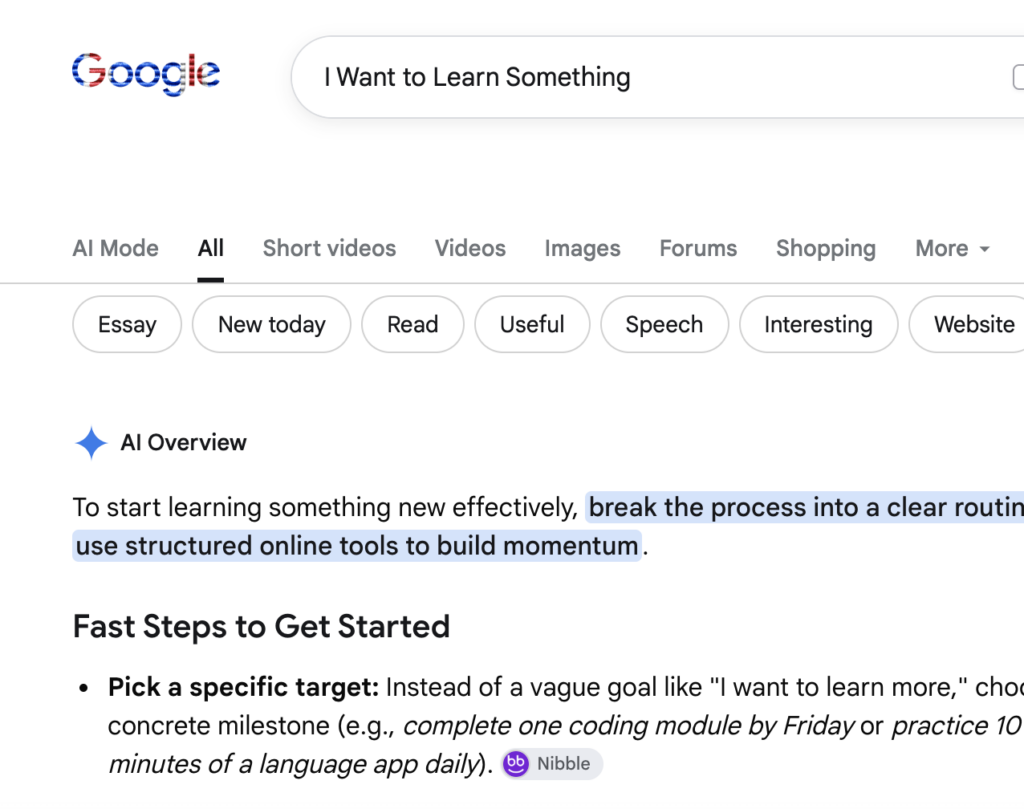
1. Informational Intent: “I Want to Learn Something”
Informational queries make up the majority of all searches. These are questions, definitions, and explainer-style searches where the user wants knowledge, not a purchase.
Examples: “what is search intent,” “how does SEO work,” “why do cats purr”
Bloggers should answer informational queries with how-to guides, explainers, listicles, and FAQ-style content. Depth matters here—Google tends to favor comprehensive content that fully answers the question rather than thin pages that only scratch the surface.
2. Navigational Intent: “I Want to Find a Specific Place”
Navigational searches happen when someone already knows what they’re looking for and uses a search engine to get there, rather than typing a URL directly.
Examples: “Jasper AI login,” “Nike homepage,” “Facebook”
Navigational intent is largely irrelevant for blog content strategy, since these searches are typically brand-specific. The exception is when bloggers compare their brand against navigational queries for competitors (e.g., “HubSpot alternatives”).
3. Commercial Investigation Intent: “I’m Comparing My Options”
Commercial investigation sits between informational and transactional intent. The user knows they want to solve a problem or make a purchase but hasn’t decided which product or service to choose.
Examples: “best email marketing tools 2026,” “Grammarly vs ProWritingAid,” “top running shoes for flat feet”
This is where comparison posts, “best of” roundups, and review content perform well. Searchers at this stage want structured, side-by-side information that helps them narrow down their choice.
4. Transactional Intent: “I’m Ready to Act”
Transactional queries signal the user is ready to buy, sign up, download, or take another defined action.
Examples: “buy Nike Air Max size 10,” “sign up for Jasper free trial,” “download Canva app”
Blog content rarely ranks for highly transactional queries—those are usually dominated by product and category pages. However, bloggers can capture adjacent transactional intent with content like pricing guides, discount roundups, or “how to get started with X” posts that include a direct path to purchase.
How Do You Identify the Search Intent Behind a Keyword?
Before writing a single word, bloggers need a reliable process for decoding intent. Here’s how to do it.
Look at the Words in the Query Itself
Certain words act as reliable intent signals:
- Informational signals: “how,” “what,” “why,” “guide,” “tips,” “examples”
- Commercial signals: “best,” “top,” “vs,” “review,” “comparison”
- Transactional signals: “buy,” “discount,” “coupon,” “deal,” “sign up,” “price”
- Navigational signals: brand names, “login,” “near me”
Analyze the Current Top-Ranking Pages
Google has already done the intent-matching work for you—it’s visible in the search results. If the top 10 results for a keyword are all product comparison pages, that’s a clear signal the query carries commercial investigation intent. If they’re all long-form guides, the intent is informational.
Choose a keyword if Google’s top-ranking content is a format your blog can reasonably produce. Skip a keyword if the top results are entirely product pages or app listings your blog can’t compete with directly.
Check the SERP Features Present
The presence of certain search engine results page (SERP) features also hints at intent:
- Featured snippets and “People also ask” boxes typically appear for informational queries.
- Shopping ads and product carousels signal transactional intent.
- Comparison tables and review stars often appear for commercial investigation queries.
How Do You Match Content Format to Search Intent?
Once you’ve identified the intent, the next step is choosing the right content format. Mismatched formats are one of the most common reasons blog posts underperform despite solid keyword targeting.
|
Intent Type |
Best Content Formats |
Example Blog Post Title |
|---|---|---|
|
Informational |
How-to guides, explainers, FAQs, definitions |
“What Is Search Intent? A Complete Guide for Bloggers” |
|
Navigational |
Brand comparison, alternatives pages |
“10 Best Alternatives to [Competitor]” |
|
Commercial Investigation |
Listicles, comparisons, reviews |
“7 Best SEO Tools for Bloggers in 2026” |
|
Transactional |
Pricing breakdowns, discount guides, sign-up tutorials |
“How to Get Jasper’s Free Trial in 3 Steps” |
Choose a how-to guide format if the query uses question words like “how” or “why” and the top results are educational. Choose a comparison or listicle format if the query includes words like “best” or “vs” and the top results feature multiple products side by side.
What Mistakes Do Bloggers Commonly Make With Search Intent?
Even experienced bloggers fall into predictable traps when it comes to intent matching.
Targeting a keyword without checking the SERP first. A blogger might assume a keyword is informational because it sounds like a question, only to find the top results are all product pages. Skipping this research step wastes writing effort on content that can’t realistically rank.
Writing one massive post to cover every intent at once. Trying to satisfy informational, commercial, and transactional intent within a single article often dilutes all three. A cleaner approach is creating separate, focused pieces for each stage of the buyer’s journey and linking between them.
Ignoring intent shifts over time. Search intent for a keyword isn’t fixed. A query that was once purely informational can shift toward commercial investigation as more products enter a market. Bloggers should periodically re-check the SERP for their target keywords, since content that ranked well a year ago may now be mismatched with evolving intent.
Overloading informational content with sales pitches. Readers searching with informational intent aren’t ready to buy. Heavy-handed promotional content in an educational post increases bounce rates and signals a mismatch to search engines.
Putting Search Intent Into Practice
Matching content to search intent isn’t a one-time checklist item—it’s a lens that should shape every blog post from the keyword research stage through final publication. Before writing, identify the intent behind your target keyword by examining the query’s language, the current top-ranking pages, and the SERP features present. Then choose a format—guide, comparison, review, or tutorial—that mirrors what’s already succeeding for that query.
Bloggers who build this habit into their workflow spend less time producing content that never ranks and more time creating posts that genuinely serve their readers. Start by auditing a handful of your existing posts against their target keywords: does the format match the intent Google has already validated in the search results? If not, that’s your next revision priority.
Frequently Asked Questions About Search Intent
What is the difference between search intent and keyword research?
Keyword research identifies which terms people search for and how often. Search intent research determines why people search for those terms and what result would satisfy them. Effective content strategy requires both: the keyword tells you what to target, and the intent tells you how to write about it.
How many types of search intent are there?
Most SEO frameworks, including Google’s own guidelines, recognize four primary types: informational, navigational, commercial investigation, and transactional. Some frameworks combine commercial investigation into a broader “commercial” category, but the four-type model is the most widely used.
Can a single keyword have mixed search intent?
Yes. Some keywords show mixed intent in the SERP, with a blend of informational and commercial results. In these cases, a hybrid content format—such as a guide that includes a product comparison section—can perform well because it addresses multiple reader needs within one post.
Does search intent change over time?
Search intent for a given keyword can shift as a market matures, new products launch, or user behavior evolves. Bloggers should periodically revisit their target keywords and compare their content against the current top-ranking pages to confirm the intent match still holds.
Is search intent more important than keyword volume when choosing topics?
Intent match matters more than volume alone, because a high-volume keyword with the wrong intent match will rarely rank or convert. A lower-volume keyword that closely matches a blog’s content format and audience often delivers stronger results than chasing volume without an intent strategy.
Wait! Before You Go, Read:
 How to Use a Keyword Cluster Generator to Plan a Blog Content Hub
 How Long Should a Blog Post Be for SEO?
 What Is Branded Search and Why Does It Matter for Your Marketing Strategy?
 5 Best SEO Tools for Bloggers – They Will Help You Get More Traffic For Your Blog
 The Secret Weapon of Smart Bloggers: Editable Slide Decks That Drive Passive Income
 Best 5 WordPress Theme Providers For Dedicated Bloggers
 4 Jedi Mind Tricks That Get Elite Bloggers to Accept Your Guest Posts
 How to Use Search Footprints To Supercharge Your Linking Campaign
 SEO Copywriting: 10 Techniques to Write for Users and Google
 How To Engage With Other Bloggers
 How to Write for Users and Search Engines: 10 Practical Steps
 Online Passive Income – 5 Money Making Ideas for Bloggers
 Super List of Tools for Bloggers – More Than 70 Resources
 Eight Methods for getting the Most out of Google Search
 How to Make Your Blog Search Engine Friendly
 Top 100 Websites For Bloggers
 [Interview] Why is WordPress Better? 10 WP Bloggers Speak Their Minds!
 Tips For Combining SEO & Content Marketing
 Solopreneur, A Fantastic Theme For Bloggers and Marketers
 5 Content Boomerang Steps for Explosive Audience Growth
 Make More Money in 2025: 12 Things Bloggers Should Do Differently
 How AI Wearables Can Help Content Creators and Online Entrepreneurs Work More Efficiently
 3 Content Strategies Your Business Needs To Thrive Online
 How to Recognize a Perfect Guest Post – Tips to Get Your Content Approved
 Ethical Search Engine Optimization Tips