Quick answer: A keyword is worth targeting when it has sufficient search volume, matches your content’s intent, aligns with your site’s authority level, and offers realistic ranking potential against current competitors. Evaluate search volume, keyword difficulty, search intent, and business relevance together rather than relying on any single metric alone.
Not every keyword deserves a spot in your content calendar. Many marketers chase high-volume terms without checking whether they can realistically rank for them, or they target keywords so niche that even a first-place ranking barely moves the needle. Both mistakes waste time and resources that could go toward keywords with genuine potential.
Knowing how to evaluate a keyword before you commit to it saves you from months of work on content that never gains traction. This guide breaks down the exact factors to weigh, including search volume, keyword difficulty, search intent, and business value, so you can build a keyword strategy grounded in data rather than guesswork.
By the end, you’ll have a clear framework for deciding whether any keyword belongs in your content plan, along with practical steps for applying that framework to your own research.
Table of Contents
What Makes a Keyword Worth Targeting?
A worthwhile keyword satisfies four conditions at once: people are actually searching for it, you have a realistic shot at ranking for it, the content you’d create matches what searchers want, and ranking for it would meaningfully benefit your business. Missing any one of these conditions weakens the case for targeting that keyword.
Many content strategies fail because they optimize for just one factor; typically search volume, while ignoring the others. A keyword with 10,000 monthly searches is worthless to you if your domain has no realistic chance of ranking on page one, or if the people searching that term aren’t interested in what your business offers.
Why Search Volume Alone Isn’t Enough
Search volume tells you how many people type a given query into a search engine each month, but it says nothing about competition or intent. High-volume keywords tend to attract the most competition, including established sites with years of backlinks and domain authority that smaller or newer sites can’t easily match.
Low-volume keywords, often called long-tail keywords, frequently convert better because they reflect more specific searcher intent. Someone searching “best running shoes” is browsing. Someone searching “best running shoes for flat feet marathon training” is close to a purchase decision. The second search has far less volume but a much clearer intent signal.
How Do You Check Search Volume for a Keyword?
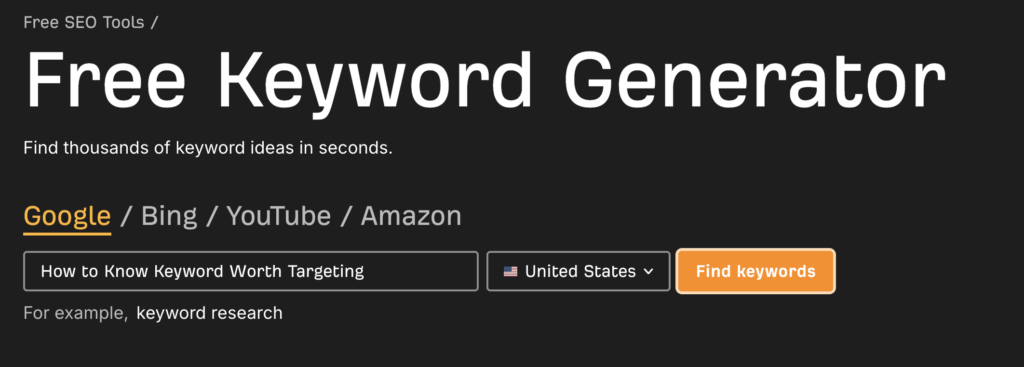
You check search volume using keyword research tools such as Google Keyword Planner, Ahrefs, SEMrush, or Moz, all of which pull estimated monthly search data from search engine query logs. These tools also show seasonal trends, which matter if a keyword spikes during certain months and goes quiet the rest of the year.
When evaluating search volume, consider average monthly volume over a 12-month period rather than a single month’s snapshot. A keyword like “tax deadline” might show enormous volume in March and April, then drop to near zero by June. If your content strategy can accommodate that seasonality, the keyword might still be worth targeting even with a low annual average.
It also helps to look at volume trends over multiple years. A keyword in steady decline, even if it currently shows decent volume, may not be worth the long-term investment of building content around it.
What Is Keyword Difficulty and How Should You Interpret It?
Keyword difficulty is a metric, usually scored from 0 to 100, that estimates how hard it would be to rank on the first page of search results for a given term. SEO tools calculate this score based on factors like the number and authority of sites currently ranking for that keyword, their backlink profiles, and overall domain strength.
A high difficulty score doesn’t automatically disqualify a keyword, but it does change your strategy. If your site is new or has limited domain authority, targeting a keyword with a difficulty score above 70 is unlikely to produce results in the short term, regardless of how well-written your content is.
Matching Keyword Difficulty to Your Site’s Authority
Compare your own domain authority (or a similar metric from your SEO tool) against the difficulty score of the keyword. As a general rule:
- Choose low-difficulty keywords if your site is new or has limited backlinks. These give you the fastest path to ranking and building early traffic.
- Choose medium-difficulty keywords if your site has some established authority and existing content in the topic area. You have enough credibility to compete without years of work.
- Choose high-difficulty keywords if your site already ranks well for related terms and has strong domain authority. At this stage, competing for harder terms is a reasonable long-term investment.
Checking the top-ranking pages for a keyword also reveals useful information. If the first page is dominated by major publications, government sites, or established industry leaders, that’s a signal the keyword may take significant time and resources to crack, no matter your current authority level.
How Does Search Intent Affect Keyword Value?
Search intent refers to the underlying goal behind a search query, and it determines whether a keyword will actually drive the outcome you want, whether that’s traffic, leads, or sales. Search intent generally falls into four categories: informational, navigational, commercial, and transactional.
- Informational intent means the searcher wants to learn something (e.g., “how to know if a keyword is worth targeting”).
- Navigational intent means the searcher is looking for a specific website or brand (e.g., “Ahrefs login”).
- Commercial intent means the searcher is comparing options before buying (e.g., “best keyword research tools 2026”).
- Transactional intent means the searcher is ready to take action, such as making a purchase (e.g., “buy Ahrefs subscription”).
A keyword can have strong search volume and manageable difficulty, but if its intent doesn’t match the content you plan to create, it won’t convert. Targeting a transactional keyword with a purely educational blog post, for example, creates a mismatch that frustrates both searchers and search engines trying to serve them the most relevant result.
How to Confirm Intent Before You Commit
Search the keyword yourself and study the top-ranking results. If the first page is filled with product pages, the search engine has already determined that intent is transactional or commercial. If it’s filled with blog posts and guides, the intent is informational. Building content that doesn’t match the established intent pattern rarely ranks well, even with strong on-page optimization.
How Do You Evaluate a Keyword’s Business Relevance?
Business relevance measures whether ranking for a keyword would actually benefit your organization, regardless of its volume or difficulty score. This requires asking whether the people searching that term are part of your target audience and whether they’re likely to engage with your product or service after finding your content.
A keyword might check every technical box, high volume, low difficulty, matching intent, and still be a poor fit if it attracts the wrong audience. For instance, a B2B software company ranking for a broad consumer-focused term might see a traffic boost without any corresponding increase in qualified leads.
Choose a keyword with strong business relevance if your priority is conversions and lead generation. Choose a keyword with strong volume but looser relevance if your priority is top-of-funnel brand visibility and audience growth. Knowing which outcome you’re optimizing for changes which keywords deserve your attention first.
What Tools Can Help You Assess Keyword Value?
Several tools combine the metrics covered above into a single research workflow. Google Keyword Planner provides free volume data pulled directly from Google’s own search index, making it a reliable starting point even if it lacks competitive analysis depth. Ahrefs, SEMrush, and Moz all offer more robust keyword difficulty scoring, SERP analysis, and competitor tracking, typically through paid subscriptions.
Google Search Console is another valuable, free resource, especially for established sites. It shows which keywords you’re already ranking for, including those just outside the first page, which often represent quick-win opportunities since you already have some existing authority for those terms.
Answer the Public and similar tools can help uncover the exact phrasing and questions people use around a topic, which is particularly useful when optimizing content for AI-generated answers and featured snippets.
Start Evaluating Keywords with Confidence
A keyword earns a spot in your content strategy when it passes four checks: searchers are actually looking for it, your site has a realistic shot at ranking for it, your content will match what those searchers want, and ranking for it supports your actual business goals. Skipping any one of these checks increases the odds that your content effort won’t pay off.
Before your next content push, run a handful of candidate keywords through this full framework rather than relying on search volume or difficulty score alone. The keywords that pass every test are the ones worth the investment.
Frequently Asked Questions
How much search volume does a keyword need to be worth targeting?
There’s no universal minimum. A keyword with just 50 monthly searches can be worth targeting if it has strong commercial intent and low competition, while a keyword with 10,000 searches might not be worth it if the competition is too high or the intent doesn’t match your content.
How long does it take to rank for a new keyword?
Ranking timelines vary widely based on keyword difficulty, your site’s existing authority, and content quality, but most sites see meaningful movement within three to six months of publishing optimized content, with continued improvement over the following months as the page earns backlinks and engagement signals.
What are the risks of targeting overly competitive keywords?
Targeting highly competitive keywords without the domain authority to back it up often results in content that never reaches the first page, wasting the time and resources spent on research, writing, and promotion. It can also delay results on lower-competition keywords that would have ranked faster.
Are long-tail keywords always a safer choice than short-tail keywords?
Not always. Long-tail keywords typically offer lower competition and more specific intent, making them easier wins, but they also bring lower individual search volume. A balanced strategy usually targets both: long-tail keywords for quicker wins and short-tail keywords as longer-term goals once domain authority improves.
What’s the difference between keyword difficulty and competition?
Keyword difficulty is a calculated score from an SEO tool estimating ranking challenge based on backlink and authority data. Competition is a broader concept that includes keyword difficulty along with other factors, such as how many businesses are bidding on that term in paid search, which can signal commercial value even when organic difficulty is moderate.
Wait! Before You Go, Read:
 A Guide to Keyword Targeting and On-Page SEO
 Ubersuggest: Keyword Research Made Easy (And Free!)
 How to Use a Keyword Cluster Generator to Plan a Blog Content Hub
 Is Blogging Worth It in 2026? What’s Changed and What Hasn’t
 9 Effective SEO Copywriting Secrets That Will Drive More Traffic
 SEO Copywriting: 10 Techniques to Write for Users and Google
 How to Rank a Blog Post on Google: Tips and Tricks!
 Should You Update Old Blog Posts for SEO? Here’s the Verdict
 5 Best SEO Tools for Bloggers – They Will Help You Get More Traffic For Your Blog
 Search Intent for Bloggers: How to Match Content to Queries
 Do You Think You Know SEO? Let’s Check It!
 What Is Branded Search and Why Does It Matter for Your Marketing Strategy?
 How to Get Profitable Keywords with LongTailPRO 3.0 – A 3300 Words Guide
 Market Samurai – Review of Great Tool for Online Marketers and SEO Specialists
 XOVI: All-In-One Marketing Suite (Alternative to SEMRush)
 Anchor Text: Overview + Best Practices (2025)
 Refinancing in a Rising Interest Rate Market: Is It Worth It?
 7 Actions To Be Taken For Blogs Seo To Get Found
 Top 10 YouTubers in the World in 2024 (Net Worth Included)
 Why Hiring Professional Auto Detailers Is Worth the Investment
 How Do You Choose a Blog Niche That Actually Works?
 Tiny Ranker: Keep Track Of Your Site Rankings And Onpage Seo Efforts
 SE Ranking: The All-Inclusive Cloud-Based SEO Software You Need
 Local SEO 101: Everything You Need to Know to Get Started
 How Long Should a Blog Post Be for SEO?